Tuesday, August 30, 2011

Adventure Playgrounds: A History


Part 2 in a 3 part series


Janet Petitpas, Senior Associate, London, Maeryta Medrano, AIA LEED AP, President of Gyroscope, Inc; Chuck Howarth, VP, Gyroscope, Inc.


What is an Adventure Playground?

The broadest definition of an Adventure Playground is a public open space where children can play and climb on structures usually made of wood, ropes and old tires (Cambridge Dictionaries Online). Early Adventure Playgrounds contained building materials and discarded industrial parts that were used by children to build with, hide in, climb on, or use in any way that they themselves directed.


Some Adventure Playgrounds continue to follow the model of building while others focus on safe but exhilarating play such as zip-wires, ropes courses and tree climbing. The level of “danger” is frequently in proportion to the level of supervision, with some Adventure Playgrounds offering no adult supervision and, therefore a lower risk of injury, and some that are closely supervised.


Overall, Adventure Playgrounds have some key attributes:

• The child acts as leader. As early childhood educator Jean Marzollo explains,“A common mistake parents make is ignoring the special ability of children to teach themselves.”

• Real stuff. Children have access to real environments and real materials. Pound the nail. Catch the frog. Build the tree house of your dreams.

• Adult support-there to help, there to encourage, but not to direct.


Adventure Playgrounds in Europe

There are some 1,000 such playgrounds in Europe, offering children the chance to build their own huts and forts from scrap materials, care for animals, or help out in the community garden. In the USA, there are still only a few such public places although many schools and pre-schools have been including elements of Adventure Playgrounds in their outdoor spaces.


The first Adventure Playground opened in Emdrup, Denmark in 1943. It was conceived by the Danish landscape architect C. Th. Sørensen, who noticed that children were more interested in playing in junk or construction areas than in official playgrounds. In 1946, Lady Allen from England visited Emdrup and was impressed enough to bring the idea of this type of playground to London.


Early pioneers in the European Adventure Playground movement also observed that children were naturally drawn to the destruction left in the wake of World War II. Rather than explore purpose-built playgrounds, children were attracted to the bomb sites of their cities and towns and could frequently be found creating their own imaginative play from materials found in these places of construction and de-construction.


The movement grew from there to include Adventure Playgrounds for children with different abilities and the concept of Adventure Playgrounds spread throughout Europe, most particularly to Scandinavian countries, Switzerland, the Netherlands, France and Germany. The first playgrounds in Switzerland opened in 1955 and in Germany in 1967. Currently in Germany, there are some 400 adventure playgrounds, Japan has a significant number, and there are 80 in the city of London alone.


While London does contain many Adventure Playgrounds, most of them describe their play areas as within the “adventure” framework, but do not have dedicated staff and therefore follow the model of lower risk and fewer opportunities for children to design their own spaces. Many of these playgrounds and parks are extremely popular and over the years I have been making the rounds with my children to see how successful they are in person.


One approach that Adventure Playgrounds have adopted is to provide a dramatic theme that children can use to organize their play and create stories around. Three of this type that are very popular in western London are the Peter Pan (Princess Diana Memorial Park) Park in Kensington Gardens, the exhibits for children at Kew Gardens, and the children’s exhibits at the London Wetlands Centre.


The Peter Pan Park includes a large boat, tepees, climbing structures, treasure chests and a water feature (only open in summer).


Children of all ages and families can be found in the park climbing and creating/acting out their own stories in these spaces. A sign at the entry mentions a staff member being present to enhance play, but I have never seen anyone there. When we first moved to London the ship included a net that kids could climb up to get to the watch tower, but this was removed by my next visit. The strength of this park is the strong narrative build around a familiar story that children can use to base as a framework for their play.


Kew Gardens has several areas for full body play for children. The two main outdoor areas are the Badger Sett and the Treehouse Towers outdoor play area.


The Badger Sett offers children the opportunity to crawl around an oversized badger nest and explore underground. Throughout the tunnels are speaking tubes, small interpretive elements about how badgers live, and light shafts to above ground. My children usually spend at least an hour here making friends with other children, inventing some group story and running through the tunnels.


The Treehouse Towers exhibit is a more traditional type of playground with the use of natural materials so that children are climbing and using real wood on their adventures.


This area is extremely popular and has a few elements that are novel, such as a zip line and large basket-like swings made of recycled materials that multiple children can use at once.


The London Wetlands Centre also contains several areas for kids to play and does a wonderful job of including beautiful landscaping with outdoor elements that children can play on. Their outdoor play area includes traversing walls, two outdoor water features, large swings and a zip wire with a launcher, which allows kids to go faster than on many zip lines.


General Playgrounds:

London is a city with a large amount of public green space and most parks contain playground areas for children. Many of them do not differ from those in the United States, but some elements are more unique.


Many playgrounds in Europe contain play equipment that spins (these have been removed from most in America) and climbing features that allow kids to get quite high. The style of play equipment in Europe has a more modernistic style, but is also being widely adopted here in the United States.


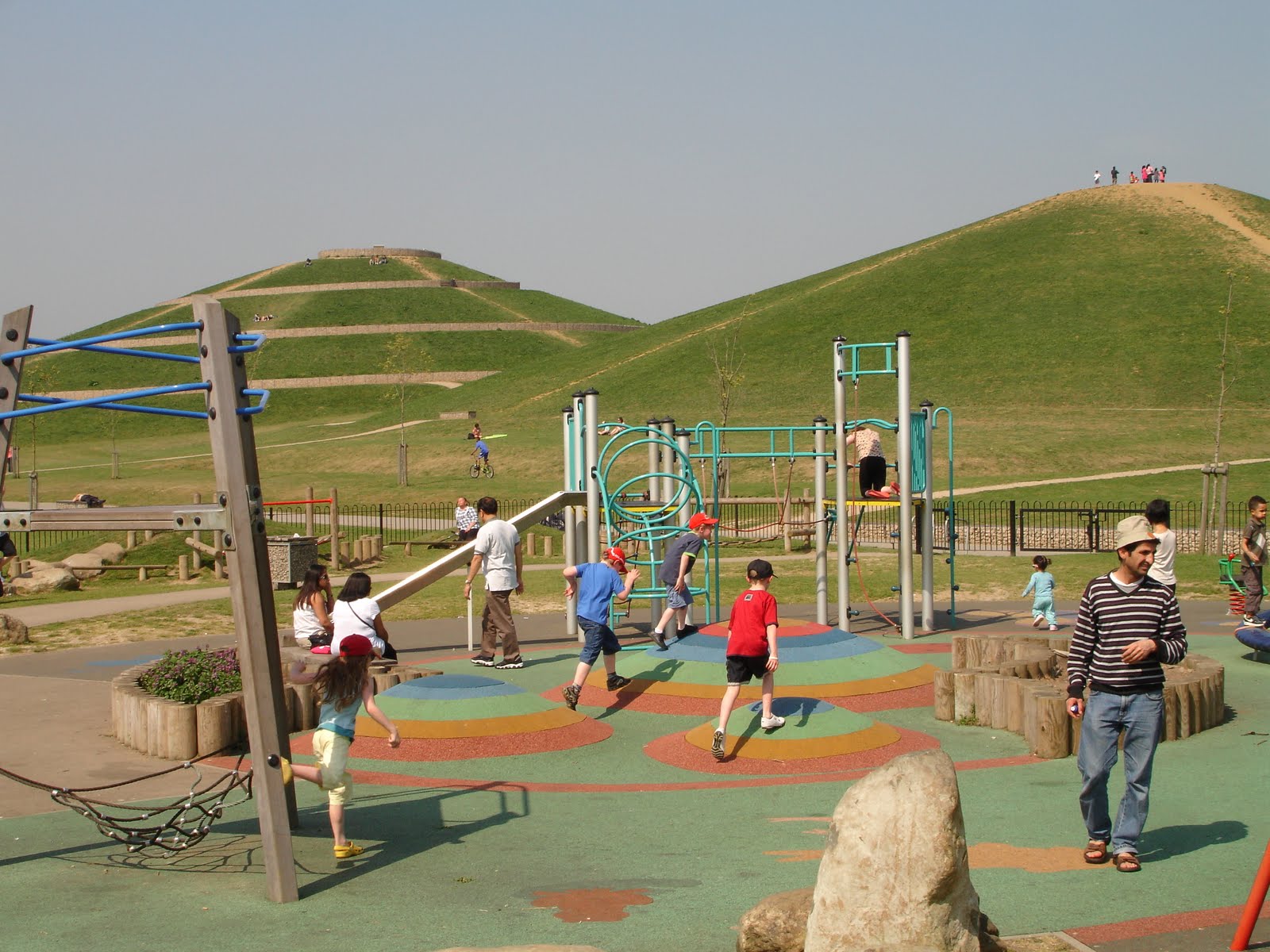
Some parks are attempting to create a hybrid and create some narrative as well as try to adapt the play equipment to be place-based and reflect the park’s unique surroundings. One such park is the new Northola Park in Ealing, which includes several small play spaces (one like a ship) and a larger play area. Surround the play areas are climbing mounds build above industrial waste sites and the large play area has small mounds that reflect the larger mounds for small children and adults who may not be able to climb the large mounds.


There continues to be great interest in providing exceptional nature and outdoor play environments for children and families. In current events, a free Nature and Play Symposium will be taking place in Austin Texas on September 1st for those interested in pursuing outdoor play further.


Tuesday, August 16, 2011

Adventure Playgrounds: An Introduction

Part 1 in a 3 part series


Janet Petitpas, Senior Associate, London; Maeryta Medrano, AIA LEED AP, President of Gyroscope, Inc; Chuck Howarth, VP, Gyroscope, Inc.


Museums, zoos, botanic gardens, playgrounds and parks within the United States have been observing and learning from our neighbors abroad about how to maximize the benefits of outdoor play environments for children and families. It is always a challenge to balance safety, maintenance, and general staffing while also providing child-led learning and creativity that natural environments can provide.


As human beings, we intuitively seek connection to the natural world and some have described this connection as “biophilia.” The term was originally used by Erich Fromm to describe being attracted to all that is alive and vital. Naturalist Edward O. Wilson suggested that biophilia is the connection that all human beings subconsciously seek with the rest of life and he proposed the possibility that the deep affiliations humans have with nature are rooted in our biology. Howard Gardner recognized the important of this connection and added “naturalistic” intelligence (having to do with nurturing and relating to one’s natural surroundings) to the now nine types of intelligence modalities included in his Frames of Mind framework.


When thinking about designing outdoor play environments for children, many American organizations have been inspired by the Adventure Playground movement that began in Europe in the 1940s. Inspired by the realization that children are currently growing up in over-scheduled, highly supervised and sanitized world that frequently keeps the natural world at a distance, a growing number of organizations (including schools and parks) are moving toward free play, natural environments.


Where it was once commonplace that kids got muddy at the edge of a pond, or skinned a knee on an old oak tree, children today have extremely limited access to wild, natural environments. In fact, in many neighborhoods, children are not allowed to explore, build forts, follow a creek, or even climb a tree due to development, covenants, zoning, liability issues, and fears of lurking danger. This lack of free exploration in the natural world cuts them off from their own adventures, narratives and discoveries. It also prevents them from learning their own boundaries, managing risk, navigating with their peer group, and utilization of their inherent creativity.


How has the movement away from unsupervised outdoor play affected children? A number of studies point to the rise in obesity, the increased use of medication for children’s behavioral problems, high blood pressure and other physical and emotional health issues that have grown over the same period of time that outdoor play has decreased. But what researchers are finding is that there is growing evidence that access to the outdoors provides important and significant benefits for children (and adults).


In Richard Louv’s book, Last Child in the Woods, there are a number of compelling statistics and studies that support this theory. When children interact with the natural world, they build their problem-solving and creative skills, learn to work with others, and gain confidence in their own abilities. What’s more, they gain a sense of ownership and mastery of their space, a sense of belonging-this is MY space. Children are natural explorers. All they need is opportunity.

Thursday, April 21, 2011

CELEBRATE EARTH DAY! Science-Based Approach for Selecting Green Products


HAPPY EARTH DAY!
I am following up on Scott's post last week about Sustainability to let other museum professionals and designers know about new online software called BEES that helps you select green products. I'm asked all the time if there is a 'certified' green products list and the truth is, there is none. There are lots of different lists and standards, as well as just plain old marketing claims. But this software tool, developed by the National Institute of Standards and Technology can help.

Years ago, one of our first clients was the California Energy Commission who first told us about the BEES software. At the time, it was in Beta testing and only for Windows users. It was not user friendly at all. Now, this version is for Mac platforms too and it's FREE!

BEES uses a science-based approach to evaluate environmentally-preferred building products including performance data and cost factors. It uses a life-cycle assessment approach and all stages are analyzed: raw material acquisition, manufacture, transportation, installation, use, and recycling and waste management.

Economic performance is measured using ASTM http://www.astm.org/ standard life-cycle cost method, which covers initial investment, replacement, operation, maintenance and repair, and disposal. The software then combines environmental and economic performance into an overall score. Here is the link to BEES software http://www.nist.gov/el/economics/BEESSoftware.cfm

So the next time you are evaluating so-called 'green products' for your museum project, you might want to check this out. ENJOY THE EARTH EVERY DAY!

Wednesday, March 16, 2011

British Libraries Case Study: Can Museums with shrinking budgets learn from Library Advocacy Efforts?

Janet Petitpas, Senior Associate, London


Government cuts in the United Kingdom are beginning to hit the arts but other areas within the public sector are also taking a beating. In London, many neighborhoods are losing libraries: Croyton will lose six libraries, Barking and Deganham will lose five, and Hounslow, the borough next to mine, will lose eight. Libraries scheduled for closure are not necessarily the least used and many of these libraries serve upwards of 50,000 visits annually.


For many Londoners (myself included), this is a catastrophe. But some communities have not been taking the news without a fight. When they learned of their libraries plan to close, The friends of Stony Stratford Library in Milton Keynes started a campaign to show how important the library was to the community. Called “Wot no books?” their grassroots efforts started with a Facebook and email call from a community member asking everyone she knew to take out the maximum number of books allowed on their card (usually 15) with the goal of emptying the library of all its resources by the end of January. The librarians supported to campaign and were please to be checking out up to 380 books an hour, although they admit that re-shelving when the books are returned will be a challenge. The librarians even arranged that the last book checked out would be Mary Norton’s The Borrowers. The community succeeded and shelves were emptied and have now had a really thorough cleaning.


The story has been picked up by press all over the world including the United States, Australia and New Zealand and is being replicated by libraries throughout the United Kingdom. The BBC covered the story in the UK and flyers were made available for those who wanted to support the effort.


The current economy puts libraries and museums in the position of articulating and evaluating their worth to the community and supporting or launching campaigns to keep or raise public and private funding. But how deep is the problem and it is uniform across institutions? How are libraries measuring their impact within their communities and how organized are their communication efforts?


Answering these questions has been a challenge as it has not been clearly articulated how the decision was made about which London libraries to close. In speaking with the senior librarian at the main branch of the Ealing Library (my main library), she explained that she has not yet heard about how cuts will affect our individual libraries. She expects that the leaders at the Borough level will be making the decisions and that these will be pushed down with little input from the community or libraries effected. A review of library services has been announced, looking at buildings and services to search for savings.


Ealing seems to have fared better than most boroughs with no closures to date. Cuts made thus far have been in personnel with open positions frozen and not filled. The senior librarian was hesitant to discuss it further because she explained that the Council is very strict about messaging and librarians are not encouraged to give their opinions.


All the same, the Ealing Libraries are doing what they can to show how the community values their services. Sponsored by the Campaign for the Book and the Ealing Alliance for Public Services, a “Read-In” was held on a recent Saturday. Participants were encouraged to bring or borrow a favorite book and read in the library, participate in discussions about their favorite work and the importance of libraries, and show how much libraries are valued in the community.


It is uncertain for both Ealing and Stony Stratford that any public display of support for the libraries will save them. Emily Malleson, the mother who started the “Wot, No Books?” campaign has said “We are still in a period of consultation on the library’s future. If 1,000 people sign the petition, the issue will automatically come up for discussion at a Milton Keynes council meeting. Despite the huge response, we don’t know what’s going to happen. We may not necessarily have made a difference.”


Although it is unsure what the impact of these actions will have, there are several positive outcomes that have come as a result that can also work for advocacy efforts in Museums:


  • The community can voice their support of an organization through concrete actions, which decrease their feelings of helplessness and deepen their commitment to that organization.

  • The network of friends for an organization can grow exponentially as the community galvanizes around a cause. As a result of the Stony Stratford campaign the library friends and Facebook groups now have hundreds of members.

  • Significant advocacy efforts can become big news stories, which can be used to show public support and make a case of the importance of public services to a community.

  • An organization can gather statistics related to its importance in the community to use for further advocacy or fundraising efforts.


As discussed in previous blog entries, museums and libraries are doing amazing and creative work in our communities. With cuts in public funding affecting everyone, the need for innovative partnerships between both types of institutions will only continue and force us to become equally creative about mobilizing our users to show and quantify their support.

Thursday, March 10, 2011

"Beyond the Didactic" a CAM Conference session on social media

Scott Moulton LEED AP


I am following up on my previous CAM post to talk about an interesting session I attended.


"Beyond the Didactic - Engaging Visitors in a Social Media World."  piqued my interest. The first panelist was Maria Gilbert from the J. Paul Getty Museum. At the Getty they participate in all the expected forms of social media but had a few interesting ways to use them to provide additional depth and engage the public. She showed how they are using Flickr to juxtapose master's work with visitor's work and show non Getty photos of historic sites to illustrate the context of a given artwork or artifact.


Sorel Denholtz is a Social Web Strategist who helped the Cal Academy use social media to engage a new audience and drive attendance to their Nightlife program. These strategies were less about moving "beyond the didactic" and more about connecting to visitors and social marketing. Nightlife is a weekly event aimed at a 21 - 35 year old crowd and features science programing, DJ performances, and drinking all within the Cal Academy. They identified 6 visitors that would become Nightlife Insiders and were given free tickets and special treatment in exchange for regular Facebook posts. The relationship was totally transparent and it helped Nightlife FaceBook page gather 19,000 fans (as compared to the 20,000 Cal Academy fans) and become a huge success.


Lisa Sasaki from The Japanese American National Museum described how their institution was using thing like QR codes and Facebook to provide more depth to an exhibit and also to be relevant to a younger generation. She pointed out the value of having more than one voice on the museum's social media and reinforced the need to have the posts or tweets  adapted to fit the different platforms.


I left feeling excited by the ways these institutions were using social media but was a bit disappointed to see that these online resources were impossible to find in the case of the Getty, and not very heavily used in the case of JANM. The NightLife Facebook page was impressive in terms of the level of activity on the site and the way they are making themselves relevant to a traditionally hard to reach audience. It will be interesting to see if other institutions can use this social marketing approach as effectively to connect to specific audiences.